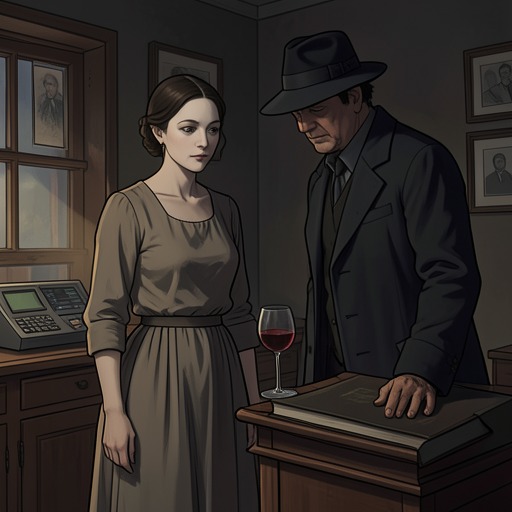
Anselmo’s test of Camilla’s chastity and the destruction of marital trust
Don QuixoteAnselmo’s test of Camilla’s chastity and the destruction of marital trust is a relationship shaped by a fatal contradiction: Anselmo trusts Camilla’s virtue, yet decides that trust is not enough unless it is tested. He recruits Lothario, the friend who helped bring about his marriage, to court his wife. The experiment meant to confirm a happy marriage instead makes its two closest bonds—husband and wife, friends—depend on deliberate deception.
Marriage and the Three-Way Bond
In Florence, Anselmo and Lothario are introduced as intimate friends whose habits and inclinations have long accommodated one another. Anselmo is more drawn to love, Lothario to hunting, but each is willing to set aside his preference for the other. Their closeness is not incidental to Anselmo’s marriage: when he falls in love with Camilla, he asks Lothario to carry his suit to her parents and negotiate on his behalf. The marriage follows, and Camilla is described as happy to have Anselmo as her husband and grateful to Lothario for arranging the match.
Lothario initially takes a cautious step back after the wedding. He thinks a friend should not keep visiting a married man’s home as frequently as he did when Anselmo was single, because a husband’s honor can be vulnerable even to a friend’s presence. Anselmo interprets this discretion as an unwelcome cooling of their friendship. He insists that marriage should not deprive him of Lothario’s company, assures him that Camilla shares his wishes, and asks him to resume visiting as before. The change that follows is therefore not caused by an existing breach between the friends: Anselmo actively calls Lothario back into the household, then gives him a role that turns their trust into the instrument of his test.
Anselmo’s Experiment and Lothario’s Warning
Anselmo explains that he wants to know whether Camilla is as virtuous as he believes. In his reasoning, virtue can be measured only when it faces temptation; a person who has never had an opportunity to fail, he argues, has not proved the strength of her restraint. He therefore asks Lothario to become the person who supplies that opportunity, reasoning that a trusted friend can court Camilla without carrying the attempt to its furthest point. He imagines that he can discover the truth while limiting the harm to intention.
Lothario challenges the premise rather than simply accepting Anselmo’s confidence. He compares Camilla to a fine diamond whose quality is already recognized: putting it between hammer and anvil would add nothing if it survived, and could destroy what the owner already possessed. He also argues that a virtuous person should not be given obstacles to overcome merely so that virtue can be demonstrated. The warning identifies the experiment’s central risk: Anselmo is not testing a stranger’s character from a safe distance but deliberately creating pressure inside his marriage and endangering a reputation he says he values.
Anselmo remains fixed on the test. Lothario fears that refusal may lead Anselmo to entrust the plan to someone less careful, so he agrees to participate while intending to satisfy his friend without actually corrupting Camilla. Anselmo embraces him and treats his agreement as a great kindness. He proposes practical means for the courtship—including opportunities to speak alone, money and jewels for presents, music, and verses—while Lothario accepts with a purpose different from the one Anselmo supposes. From the start, then, the arrangement contains two deceptions: Anselmo disguises a dangerous experiment as a proof of love and trust, while Lothario pretends to undertake a genuine pursuit in order to prevent the scheme from going further.
The Test Enters the Household
Anselmo first watches Lothario closely and discovers that he has not spoken to Camilla. Challenged over this concealment, Lothario promises to proceed without further deception. Anselmo then arranges to leave Florence for eight days, setting up an absence that he presents as a chance for Lothario to carry out the courtship. He instructs Camilla to receive Lothario in his home and to treat him as she would her husband. Camilla objects that it is improper for another person to take Anselmo’s place at table and says she is capable of managing the household herself. Anselmo insists that she obey his wishes, and she submits reluctantly.
Camilla tries to maintain boundaries within the arrangement her husband has imposed. She receives Lothario courteously but avoids being alone with him, keeping servants nearby and relying especially on Leonela, her companion since childhood. She directs the household so that Leonela will remain with her, but Leonela does not always follow those instructions. Meanwhile, Lothario’s silence does not keep the situation unchanged: watching Camilla and reflecting on her qualities gradually alters his own feelings. The plan Anselmo had imagined as a controlled test begins to generate desires and risks that neither the husband’s confidence nor the original bargain can contain.
When Lothario later presses his suit, Camilla’s resolve weakens under his appeals, praise, and apparent sincerity; she yields to his advances. Leonela alone knows of the breach, while Anselmo remains unaware. The shift is decisive because the test has not merely exposed a quality that existed independently of it. Anselmo’s arrangement has helped create the circumstances in which the marriage is endangered, while Lothario’s promised restraint has given way to his own pursuit.
False Assurance and Damaged Trust
After returning, Anselmo does not recognize what has changed. He visits Lothario and asks how the test has gone. Lothario reports that Camilla has rejected his words, promises, presents, and feigned tears, and describes her as a model of purity and modesty. He returns the money Anselmo supplied and urges him to be satisfied rather than begin another trial. Anselmo believes this account completely, as though it were an authoritative judgment. Yet Lothario’s report is false, and the reassurance that appears to confirm the marriage is actually part of its concealment.
The relation has therefore been damaged on several levels, even as Anselmo thinks his purpose has succeeded. Camilla’s fidelity has been exposed to a situation her husband deliberately created; Lothario has crossed from loyal friend to concealed lover and liar; and Anselmo’s confidence now rests on a false report from the very friend he chose as his examiner. The experiment’s irony lies in its method: Anselmo seeks certainty by making trust answer to a trial, but the trial produces secrecy instead. In the portion of the story represented here, he remains satisfied with Lothario’s assurance, while the truth that could explain the change in their relationship remains hidden from him.